Do Chinese cars hold their value? So far, yes, except in Saudi Arabia
At three years old, Chinese models keep 74% of their one-year value across the GCC, against 67% for Japanese models.
Resale is the fear that follows every Chinese car in the Gulf. In public discussion it comes up less often than price or service, in 7% of items, but almost always as a worry about fast depreciation. AutoData's listings let us test it.
We compare each model with itself: the same make and model, in the same country, at different ages. Across the GCC, Chinese models listed at three years old ask 74% of what the same models ask at one year old. Japanese models ask 67%, and European models 68%.
At three years old, Chinese models keep 74% of their one-year value; Japanese models keep 67%
Asking price by age relative to the same model at one year old; within-model comparison, five countries (Oman prices under review)
The picture differs by market. In the UAE, Chinese models keep 80% at three years against 56% for Japanese models. In Saudi Arabia the order flips: Japanese models keep 81%, Chinese models 73%.
The first year tells the same story. One- to two-year-old Chinese cars are listed at 90% of the asking price of the same model new, against 83% for Japanese and 73% for European models, the three origins with enough comparable listings to measure.
Young Chinese cars list at 90% of the new price
Asking price of one- to two-year-old used cars as a share of the same model's new-car stock price, median across models
Read with care
- These are asking prices, not transaction prices.
- The Chinese fleet is young, so the comparison covers the first three to four years only.
- Falling new-car prices for Chinese models narrow the gap between new and used, which flatters retention measured against new stock.

The Chinese Wave: how Chinese brands are reshaping the GCC car market
Three in ten nearly new used cars for sale in the GCC are now Chinese. Six findings on share, price, warranty and value retention from 438,895 live listings.
14 October 2026 · 2 min read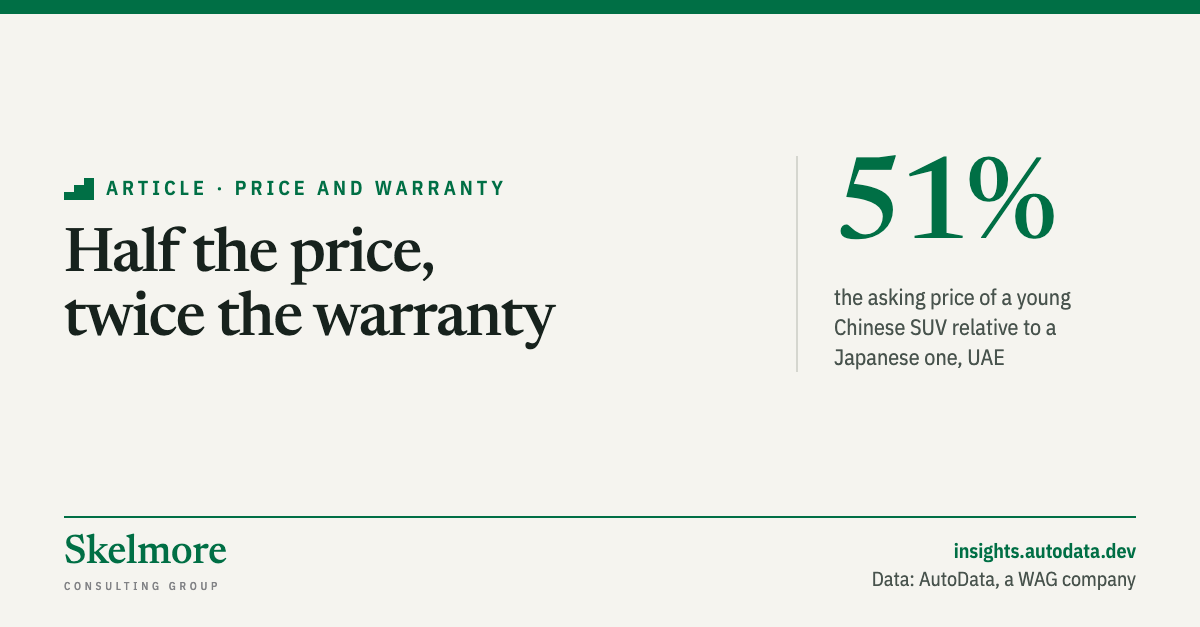
Half the price, twice the warranty
A young Chinese SUV is listed at 51% of the asking price of a Japanese one in the UAE, and Chinese distributors offer up to 7 years of warranty against Toyota's 3.
14 October 2026 · 2 min read